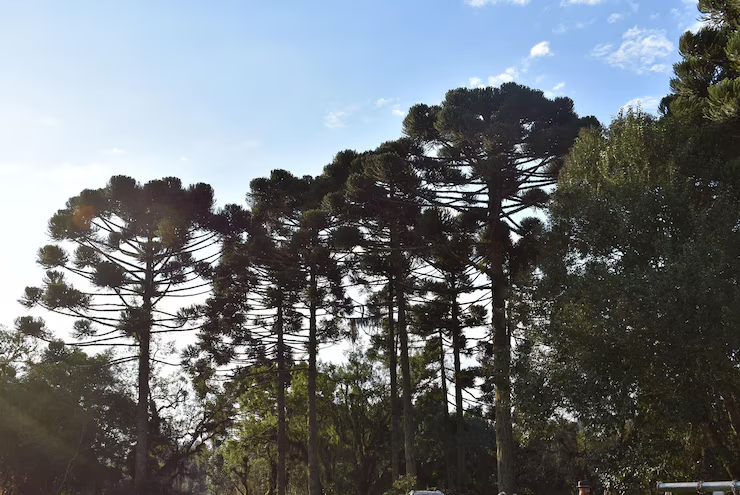
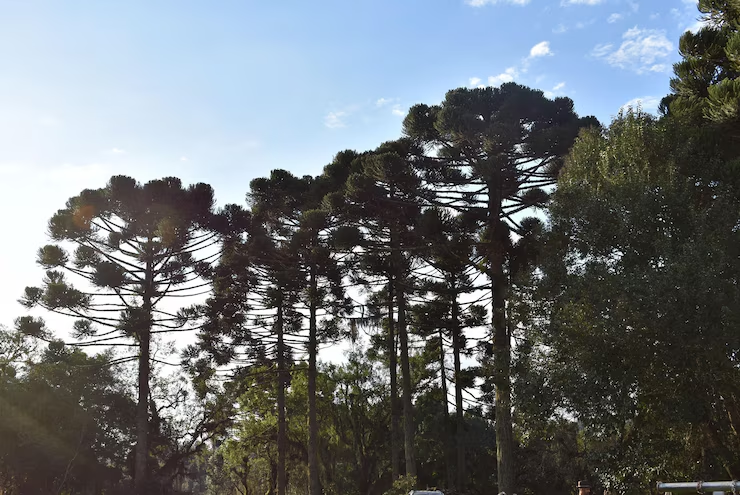
The Argentine NGO Banco de Bosques raises funds to rescue and restore native forests threatened by illegal logging and deforestation. Today, its campaign focuses on gathering donations to save an araucaria forest located in the heart of the Misiones rainforest.
It was 1835 when Sir Charles Darwin, then circumnavigating the world aboard the HMS Beagle, stopped on the Pacific coast and ventured inland. There, he witnessed a fossil forest composed of 52 magnificent millenary araucarias, all standing tall as if still alive. This moment, which captivated his scientific curiosity, took place in Paramillos de Uspallata, Mendoza, and was recorded for posterity.
Today, new records are shaping the history of Argentina’s native forests—though the story they tell is a different one. Instead of remarkable natural discoveries, they reflect deterioration. Data shows that in Misiones, native araucaria forests have lost 99% of their original area. Across the country, only 30% of native forests remain standing. And despite the existence of the Forest Law since 2007—which establishes criminal penalties for violations—Argentina continues to lose one hectare of native forest every three minutes. Each loss constitutes an ecosystem at risk.
In response, Banco de Bosques has launched a donation campaign to change this chapter of the story and protect what remains of the araucaria forests in the Province of Misiones.
“Today we all have the opportunity to be like Perito Moreno. Francisco Pascasio Moreno (1852–1919), the Argentine scientist and explorer who loved Patagonia, was a pioneer in donating his land to create a national park. Today, each of us can follow in his footsteps and act in favor of conserving our country’s native forests. We are particularly focused on saving the remaining araucaria forest in Misiones,” explains Emiliano Ezcurra, director of Banco de Bosques.
A long road ahead to save the araucarias
Ezcurra’s reference to “following in the footsteps of Perito Moreno” recalls the creation of Argentina’s first national park—Nahuel Huapi—in 1934, made possible by Moreno’s donation of 7,500 hectares for the enjoyment of future generations.
Banco de Bosques seeks to replicate this gesture. “Our work consists essentially of identifying forests in critical condition and raising funds to save them. A forest in critical condition is one that goes up for sale on the land market and is destined for logging to convert it into agricultural plots. With funds raised—from small monthly contributions to large philanthropic gifts—we purchase the forest and then donate it to the National Parks Administration,” Ezcurra explains.
He recounts how, in 2009, he saw a newspaper advertisement listing a forest for sale. That moment sparked the idea of creating a platform to raise funds and buy as many forests as possible. “Our major fundraising campaigns rely on what we call ‘georeferenced donations.’ This means connecting each donor to the exact square meters they help protect. Donations range from small monthly contributions—like the 2,000 pesos from everyday citizens—to corporate contributions to offset carbon footprints, and even multimillion donations from philanthropists committed to conservation. All contributions matter and make a difference,” adds Ezcurra, who served as vice president of the National Parks Administration from 2016 to 2019.
The results of a bold initiative
Ezcurra proudly notes that the organization has managed to save four large native forests in Argentina so far—one in Santa Cruz, one in Chaco, and two in Misiones. Now they are fully dedicated to a new campaign: saving a fifth forest, this time an araucaria stand.
“This native forest is located in the middle of the Misiones rainforest. It is a unique and magical place, home to a key ecosystem rich in araucarias. Ninety-nine percent of this type of forest has already disappeared. The remaining 1% we are trying to save is extremely valuable—a dream we want to fulfill for the country, for the future and for preserving as much as possible of the Misiones ecosystem. It is a natural gift we Argentines have, and we must make every effort to protect it,” concludes the environmental specialist.