
NASA, National Geographic, and Lindblad Expeditions support the race-against-time work of Zaria Forman, an artist who captures the agonizing voice of the world’s glaciers. Thanks to their financial backing, Forman — equipped with charcoal and pastels — can travel to the frozen edges of the planet to portray, with millimetric precision, the colossal ice forms that are collapsing under global warming. Her majestic and singular work communicates an urgent plea for awareness and action from an environmental artist who turns crisis into testimony.
“As an environmental artist, my work has always sought to become a channel of communication between nature and people. I aim to make the invisible visible: that deep emotional connection that exists with these ice giants, majestic yet fragile and vulnerable at the same time,” Zaria says as she gestures toward one of her pieces.
Contemplating any of her drawings, made solely with charcoal and a few pastel tones, feels similar to standing before a glacier. At monumental scale, the forms convey the force and the cold of their real presence.
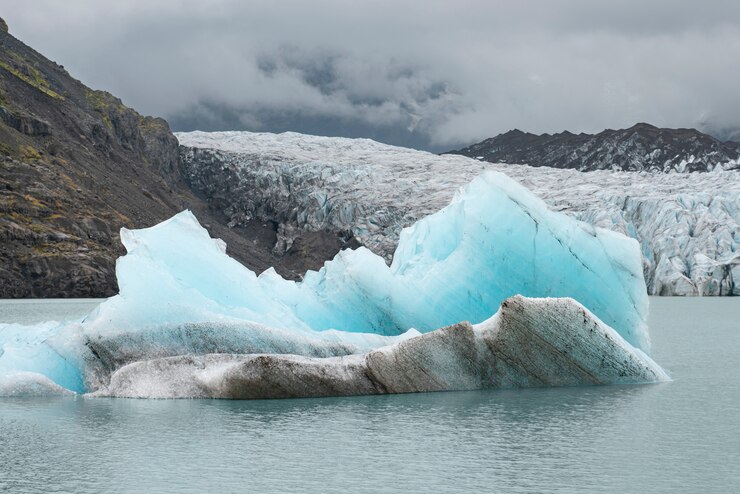
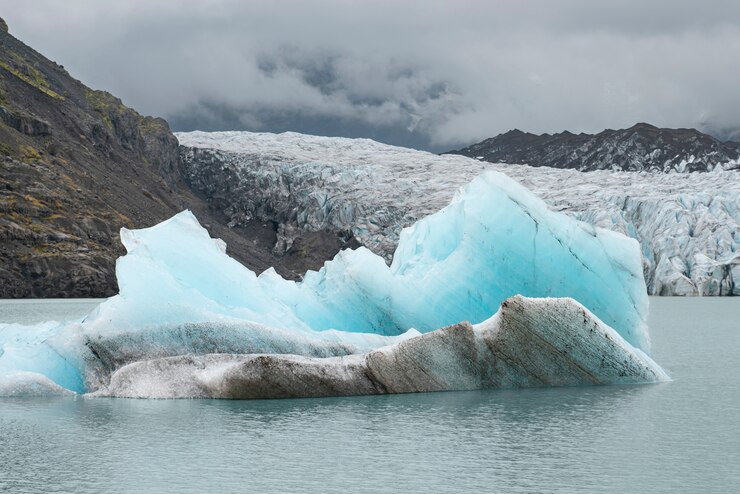
Zaria’s connection with glaciers is astonishing. Her ability to recreate them is so precise that it becomes difficult to distinguish her drawings from enlarged photographs. “In order to capture the natural setting — sublime, and extremely vulnerable — of the polar regions, I work from large-format photographs. In them, the fractured patterns of the ice, its unpredictable geometry, and the multiple shades of blue that appear are a vital path, the trace that bears witness to the pressure of climate change and the passage of time.”
An Artistic Mission With NASA Scientists
NASA selected Zaria Forman to join an aerial mission during 2016 and 2017 focused on documenting the advance of climate change in the polar regions. For the scientists, Zaria’s eye was essential for capturing, from the perspective of art, how rapidly the frozen landscapes were transforming. The fundamental reason behind NASA’s inclusion of an artist on 12-hour glacier flights was to ensure that Forman could later communicate this silent crisis to the world.
Glacier collapse occurs in remote corners of the planet, far from cities, and for experts who study these ecosystems, their disappearance is something the world should grieve. Art, in the hands of an artist with a remarkable connection to these magical environments, becomes an indispensable tool to awaken global awareness. For NASA, Forman’s artistic precision can be more powerful and effective than a scientific report filled with data and statistics.
“I am grateful to NASA for giving me the chance to see the glaciers from above. This journey has been an odyssey, a unique opportunity that has given me a new perspective on the environment I love and on which my entire artistic career is based. The 95 hours of flight over the polar landscape enriched me as an artist and deepened my sense of responsibility as an environmental creator,” the young artist recalls. “My hope is that my drawings, my canvases, serve as a springboard for many to discover the beauty and complexity of these regions, to which we are intrinsically connected,” she adds.
Glaciers in Full Screen
The 42-year-old artist has spent more than a decade visiting and studying the polar regions in depth. There, she devoted time and effort to documenting every landscape, every sky tone, every bird that crossed it, and every detail she could observe in the ice blocks. As she often explains, “Ice has its own personality; the whole is a single entity that speaks, even in the silence, like a vast backdrop.”
Her favorite moments alternated between contemplating the ice formations and the pause at day’s end, when she returned to base, reviewed the day, and sketched ideas for future works. “Before sleep, I always set aside a quiet moment to connect with what I had experienced with the glaciers. I would take out my charcoal and pastels to create sketches of the hyper-realistic portraits of the ice blocks that had moved me that day. My hope then — and still today — is that people can appreciate the beauty of these melting giants. My hope is that by connecting with their beauty, people will wake up and help save them,” she concludes.