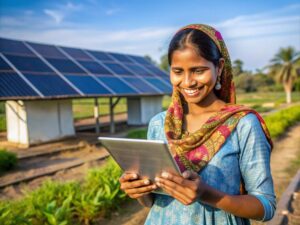
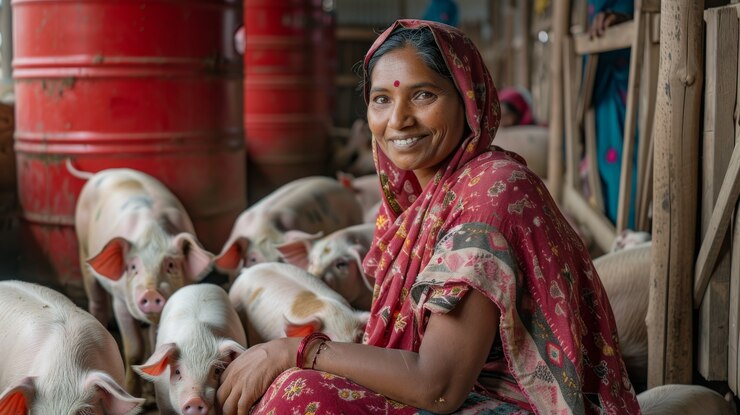
Thanks to the empowerment and training programs for women promoted by the World Bank (WB) in India’s poorest and most vulnerable regions, many women have become the pride of their villages. It is a story of perseverance and determination—of women who fought to create better livelihoods and who continue to inspire others to step out of their comfort zones and succeed on their own merits.
Kunta Devi, a villager from Bara, is not an ordinary woman. Sitting upright against the mud wall of her modest home, she commands respect and admiration. Her house—a small, single-room hut in eastern India—may be humble, but that doesn’t matter to her. She proudly calls herself an “empowered entrepreneur.” Speaking of her present, she says: “Now people know me and call me by my name. I’ve earned my place, and they respect me. But just five years ago, I was no one,” Devi adds.
Indeed, without the financial support made possible through World Bank programs, Devi’s current reality—one she holds with pride—would never have been possible. The World Bank has maintained close ties with India since 1948, channeling significant financial resources toward ambitious development and assistance projects.
Through this steady support, the Bank has helped strengthen food security in the country and protect its most vulnerable populations through complementary actions—such as advising developing cities and urban centers on improving management capacities to foster economic growth. For Devi’s family, this translated into a life-changing opportunity: access to a World Bank grant that enabled her to purchase a few goats and begin her own small-scale business ventures. Today, that first step has made her the village’s leading entrepreneur.
Financial Support: A Catalyst for Development and Action
Devi was born into one of India’s lowest castes. Vulnerability, exclusion, and social rejection were part of her daily life, yet fate compensated her with a good husband and eight healthy children.
Her life changed overnight when her husband suffered a severe injury and could no longer work. Suddenly, the family’s survival depended entirely on her shoulders. Watching her children go hungry and cold was unbearable. With courage, she stepped out of the shadows and made a decisive move—she sought help in the right place.
She joined a small group of women entrepreneurs in her village who were part of a World Bank–sponsored program. After receiving moral support, training, and encouragement, she applied for a microloan from the Bank at a minimal interest rate, which allowed her to purchase goats and start a breeding project. It was a success. Encouraged, she requested a second loan to lease farmland and grow cereals—another initiative that thrived. Over time, she managed to repay both loans and set her sights even higher.
On the Path to Development
Today, Devi and her family enjoy a more promising future, with multiple sources of income. She dreams big and continues to plan ahead. Her next goal, if fate allows, is to open a small restaurant in the busiest part of her beloved town of Bara. She also hopes to move her family into a new home.
Undoubtedly, Devi and her fellow group members—now all empowered, entrepreneurial women—are the pride of Bara. They still face challenges and new paths ahead, but the transformation they have achieved through the World Bank’s training, guidance, and support is remarkable and deserves recognition. It is an extraordinary true story of empowerment and success, born from the power of collective action.
“Hunger and our children’s needs pushed us forward. The rest unfolded along the way. Doors opened—but often, we just had to guess the next step,” Devi concludes, with a quiet sense of pride.