
In 1605, Pope Paul V Borghese was elected successor to St. Peter and set out to transform Rome into a stage for drawing the faithful through celestial art. To achieve this, he needed sculptors, artists, and engineers capable of creating monumental, striking, and glorious works. Under the protection of the Vatican, Gian Lorenzo Bernini—the great sculptor and architect—unfolded an astonishing body of work that endures to this day.
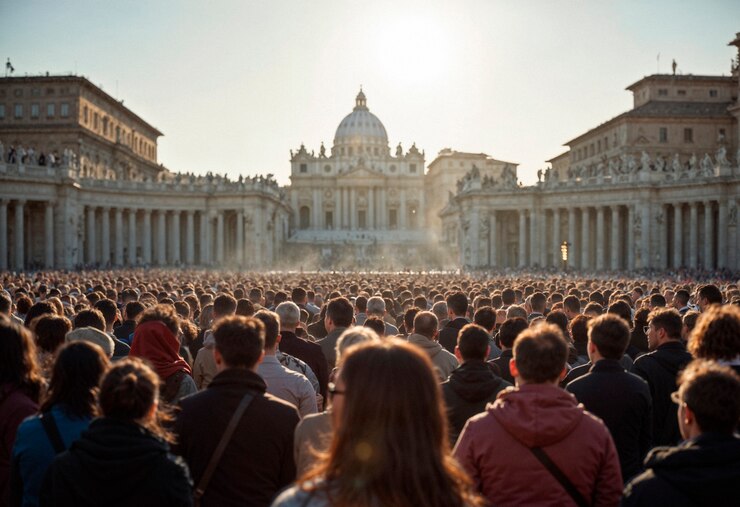
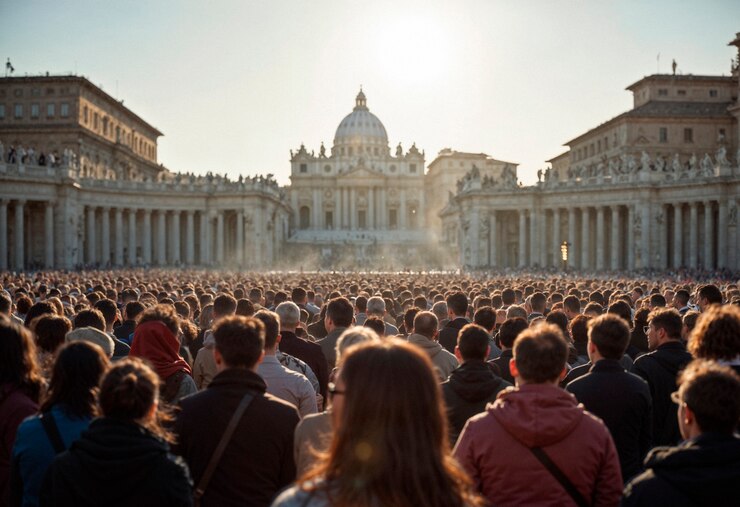
Imagine the scene: a seventy-year-old man, distinguished in appearance, walking slowly toward the center of St. Peter’s Square. Focused on each step, his cloak sways in the wind as he gazes around him with a faint smile—the towering colonnades that embrace the square’s perimeter, the many figures and ornaments, and the sculptures of the twelve apostles that crown the columns in radiant splendor. This was the work of his own hands. The work of his life.
Yet when Gian Lorenzo Bernini—considered the most exceptional sculptor of all time—first took a chisel in hand to breathe life into the marble that now adorns St. Peter’s Square, he was still a young man. His life was just beginning, and his patrons, with their steady flow of funds, protected and encouraged him to fulfill his purpose: to create monumental art in service of the Church.
Throughout his extraordinary career, Gian Lorenzo Bernini was supported by several patrons. His was a prodigious trajectory, moving from one masterpiece to the next, almost without setbacks, always ascending toward the heavens—his natural and inevitable destination. History tells us that Bernini had many patrons: men who loved and valued art as the highest expression of the spirit; men who, upon seeing his sculptures, wagered everything on his talent and his vision. Among them, however, two stand above the rest: Scipione Borghese and Pope Urban VIII—without whom many of Bernini’s most remarkable works, including the very architecture of St. Peter’s Square, would never have been possible.
Art in Harmony with the Language of Heaven
One of Bernini’s most influential patrons, who commissioned several of his most splendid works—including the celebrated David—was Scipione Borghese, nephew of Pope Paul V (1605–1621). Upon Paul’s death, his successor, Pope Urban VIII, elected in 1623 as the next successor of St. Peter, appointed Bernini as the leading artist of the papacy—its principal sculptor and architect. It was a period of absolute splendor, one that allowed him to fully flourish as an artist while fulfilling commissions near and far, all under the Vatican’s patronage.
This man—brilliant and prolific beyond compare—could have acted as though the place belonged entirely to him. But of course, he did not. He knew he was not the owner of his work. St. Peter’s Square had long been under the exclusive domain of papal will. Yet it was Bernini who conceived it in his mind, designed it inch by inch, and finally brought it into being. He was Gian Lorenzo Bernini, and he knew that what he had created was a true masterpiece of architecture. Without a doubt, St. Peter’s Square would secure his place in history. In a way, he was the rightful master of all that surrounded him—of everything he beheld.
In 1680, just months before his 82nd birthday, Gian Lorenzo Bernini—the genius of Baroque art and architecture, of lines charged with movement and seemingly impossible in their realism—died of a stroke. During the seventeenth century, he was, in practice, the artistic director of the Vatican, of Rome itself. On that grand stage, he left an indelible mark for posterity, giving life to one of Catholicism’s most monumental creations: St. Peter’s Square.
From museums to magnificent churches, from bridges to plazas, Bernini enriched countless corners and landmarks of the Eternal City with his work. There, carved forever into marble and stone, remain a style and energy as unique as the world has rarely seen. For this reason, all those fortunate enough to visit Rome—or to live there—will forever be, in some way, indebted to him: to Gian Lorenzo, the artist of prodigious art and generosity, and of course, to his patrons as well.