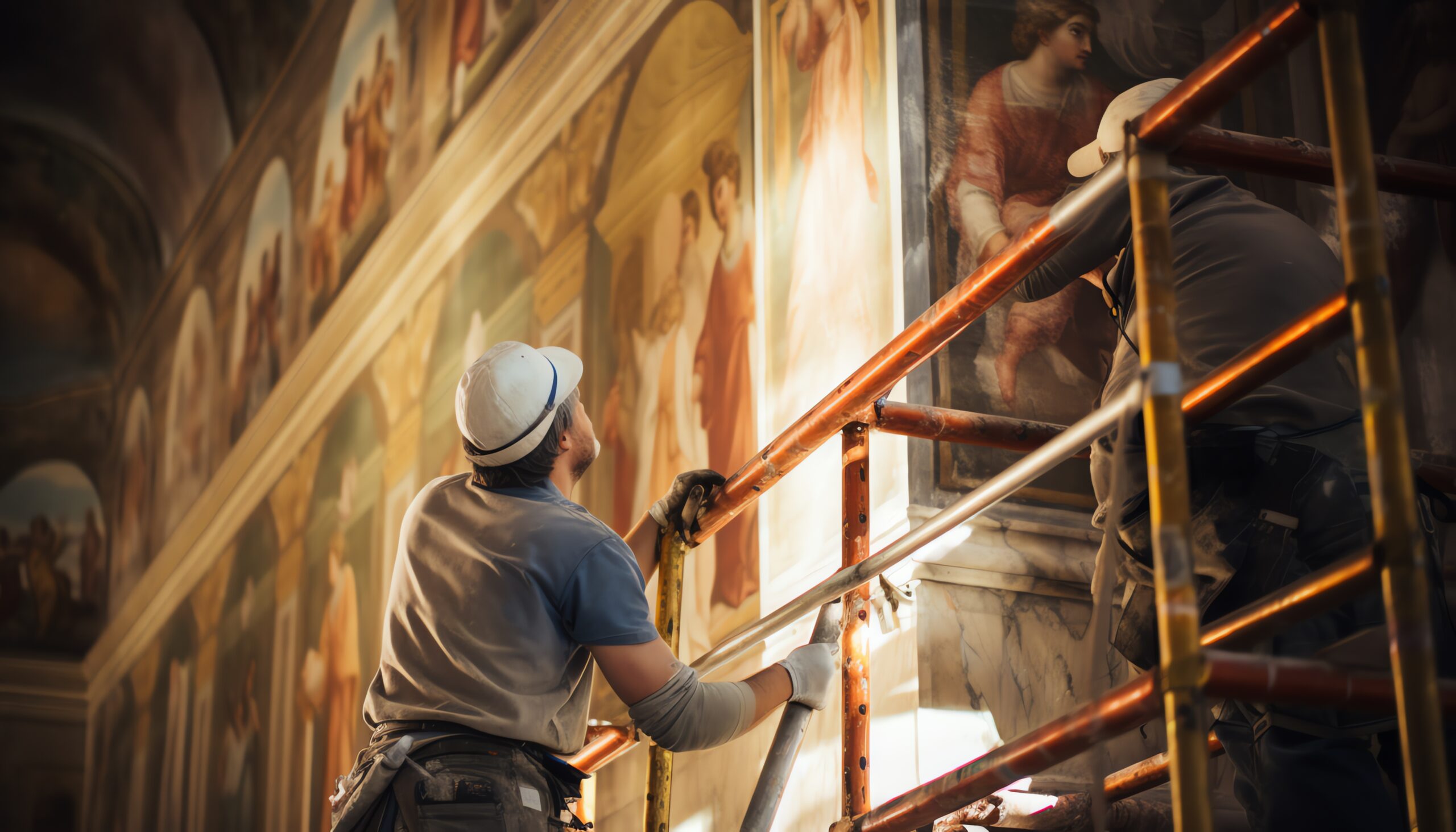
Affected by the weather, the building entered a phase of severe deterioration, and the need for restoration became urgent. For this reason, through the “Donate a Tile” campaign, launched by the rector of the Basilica, efforts are being made to raise €1.6 million in donations to complete the €3 million required to restore this imposing 18th-century basilica. A jewel of Madrid’s and Spain’s architectural and cultural heritage that cannot be lost.
In the heart of Madrid, a jewel of Italian Baroque is on the brink of collapse. This is the Pontifical Basilica of San Miguel, whose structure is slowly sinking into its own foundations, endangering an 18th-century architectural masterpiece of incalculable value. “The heavy and persistent rains that have battered the city have made the problem worse; several pieces of masonry have fallen from the roof, causing further damage,” recounts Pío Santiago, rector of the Basilica.
That is why the idea of launching a crowdfunding campaign to raise funds “fell from the sky.” Although the total amount has not yet been reached, the first stage of the restoration work is already underway. The overall cost amounts to €3 million to fully restore the roofs and façades. “Beginning the work is urgent for us. Literally, we cannot delay any longer,” explains the rector. Named “Donate a Tile,” the campaign, according to the Basilica’s website, had already raised €1.4 million by April 2025. For those wishing to contribute, there is no minimum donation—every amount helps, whether €25 or €100. Contributions can also be made by bank transfer. With enthusiasm, Pío Santiago clarifies that there is strong hope of soon completing the remaining €1.6 million, thanks to the positive response from the faithful who have already contributed €1.4 million.
A majestic, unique, and splendid temple
Declared a National Historic-Artistic Monument and an Asset of Cultural Interest (BIC), the Basilica of San Miguel is renowned for the procession of the Brotherhood of Students during Holy Week. As a temple, it is truly unique, and among Spain’s architectural treasures, it stands as the foremost example of the Italian Baroque style. Its ancient pipe organ, delicately assembled and adorned with golden detail, is majestic. It still retains its original 18th-century case and is considered, for the quality of its sound, one of the finest in the city. “And the Basilica is the only one in all of Spain to have authentic doors dating back to the 17th century. They are of polished wood and their preservation is impeccable,” stresses Pío Santiago.
Santiago also recounts having appealed directly to the Vatican for funding. “We have requested the nuncio’s formal management with the Vatican. But for the moment, we are still awaiting a response. On the other hand, both the City Council of the capital and the Community of Madrid have heard our request for financial assistance, but so far, we have not received a positive answer nor any support. Still, we remain hopeful and trust that help will come at the right time.” Under these circumstances, most of the funds for the most urgent repairs will need to come from donations by the faithful and private individuals, as well as offerings collected during Mass. “A beam broke, but fortunately, for now, it could be supported with a temporary brace. Technically, the experts who assessed the situation said there is no danger for people. For that reason, we continue holding Masses, baptisms, and weddings.”
Upon entering the Basilica of San Miguel, on one side stands a device similar to an ATM. Though it contrasts with the sacred paintings and images around it, it is clearly visible, with an explanatory sign beside it informing visitors—whether regulars or first-timers—about the “Donate a Tile” campaign. Children attending Sunday Mass with their parents are almost naturally drawn to this corner, seeing it as an ideal spot for impromptu games. Yet in reality, this is where the faithful can make their donations at any time of day. “We believe that preventing this beautiful temple, a reflection of the splendor of Italian Baroque in Spain, from falling into complete ruin is not only a matter of ensuring the safety of all who visit this place of worship, but also of preserving it for posterity, given that it is part of Madrid’s Historical Heritage,” concludes Santiago.