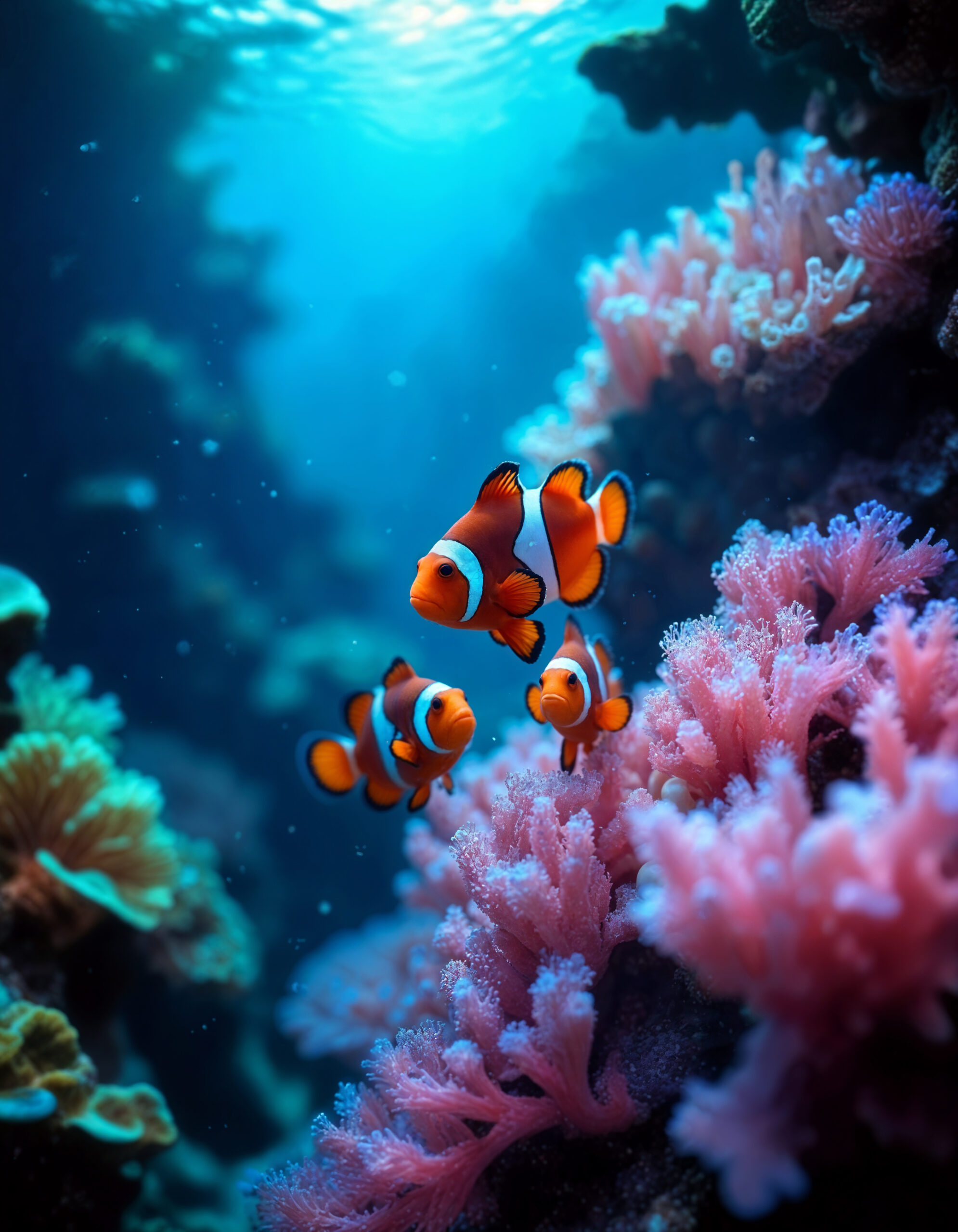
The donations received month after month by the NGO Efecto Arena are small but invaluable contributions to the conservation of Mexico’s coral reefs. Essential funds that, in Bahía de la Paz, Baja California, are used for coral gardening and environmental education—two key pillars to prevent the massive loss of corals which, threatened by rising ocean temperatures and increasing marine pollution, have drastically declined: 50% of the planet’s remaining corals are now struggling to survive.
The divers of Efecto Arena’s team descend regularly to scrutinize the silent seabed. There, they carry out an environmental mission that, in the context of severe climate change and mounting challenges, many describe—Hollywood-style—as a “mission impossible.” The truth is that, like tiny ants or drifting specks, almost imperceptible in the vastness of the blue ocean, they dive in search of damaged corals—those battered by sudden waves, the force of hurricanes, or human hands. With painstaking attention, like seasoned marine detectives, they collect those minute fragments broken off from the main coral wall, later to be planted in an underwater nursery.
Thus, Efecto Arena’s divers set the wheel of hope in motion for an ecosystem essential to marine life. “This is possible thanks to the funds we receive and the support of people,” say team members who carry out this “mission impossible.” Racing against time and fending off despair, their action is like throwing a bucket of water onto a raging fire—but, they insist, far worse would be to stand idly by.
Fragile as the most delicate of fabrics, vulnerable to high ocean temperatures and the multiple forms of pollution unleashed in the marine environment, half of the coral reefs once held by the planet have already succumbed. This irreplaceable loss has dragged with it thousands of organisms, fish, and marine flora and fauna that depended on them for shelter and quality nutrition. But the divers and the entire Efecto Arena team have an unyielding commitment: they will do everything—and more—to ensure the corals of Bahía de la Paz, Mexico, withstand the onslaughts of our time. Because they know that anyone who has had the chance to dive along a coral reef and admire the beauty of this aquatic ecosystem—filled with small, dazzling creatures in astonishing, vibrant forms teeming with life—will understand their feelings. “To love corals and their shimmering life is to love nature itself, and that means caring for it and preserving it,” the divers say.
A Very Particular Nursery
“At first, the nursery garden corals look like a small, timid twig. As they grow, they take a shape similar to a tiny broccoli head. Over six months, they receive constant supervision, maintenance, and cleaning. Being in an aquatic nursery does not mean they are safe. Other fish come here trying to eat them. Once they reach the right size and structure that allows them to survive, they are transplanted back to the reef walls,” explains Jorge Cáceres Puig, director and biologist at Efecto Arena.
The incubation process—the first step in the rescue strategy—is carried out on the nursery beds. These large structures are made of PVC piping and serve as the place where coral fragments are cultivated. Here, specialists prepare the bases that support each “hopeful sprout,” which is then fixed to the reef rock with epoxy resin. “It is gratifying to watch an ecosystem slowly emerge around the nursery. Biological complexity begins to increase: ocean life arrives. These new organisms attract juvenile fish and other invertebrates that find shelter here and, once developed, leave. This generates an ecosystem that, in turn, creates more life for the rest of the ocean,” adds Cáceres Puig.
Unfortunately, not all attempts succeed, and some transplanted corals do die. Yet, the methodology used at Efecto Arena allows for replacing these coral colonies. “At present, survival rates for corals transplanted from the nursery are between 80 and 90%. Fortunately, today we can replace those that have not survived,” explains Dr. Cáceres Puig. “In this respect, there is a strong similarity to what happens with trees. It is not only about planting a single tree—which is positive in itself—but about how we build a forest. In our case, specifically, a reef.”
Ultimately, the most important part of all the restoration work is seeing the small sprouts grow and the life that arrives at this aquatic garden, which in turn attracts new life. Helping the reef continue fulfilling its vital functions here, in this ecosystem where Mother Nature placed it—in Bahía de la Paz, Mexico—is deeply rewarding, a true song of life, and something that fills us with pride,” concludes Dr. Cáceres Puig.